AEGIR: Modeling Area Emitters for Indoor Inverse Rendering using Gaussian Splatting
June 2026
Abstract
Inverse rendering requires separating illumination from surface materials, which is highly ambiguous due to their tight coupling in observed images.
While Gaussian Splatting is efficient for novel view synthesis, existing relightable methods approximate scene lighting using discrete point lights, global environment maps, or implicit representations.
By ignoring the physical spatial extent of real-world emitters, these approaches produce incorrect light attenuation and unrealistic shadows.
We present AEGIR (Area Emitters for Gaussian Inverse Rendering), a framework that explicitly models local area emitters within a relightable Gaussian Splatting representation.
Joint optimization of emitters, materials, and geometry is challenging due to flexible emitter parameterization, which increases both the number of parameters and the ambiguity between illumination and materials.
We address this by introducing a differentiable deferred rendering pipeline that integrates multiple importance sampling with targeted regularization.
As a result, AEGIR accurately simulates local light transport and achieves more consistent decomposition.
Experiments show that explicit area emitters improve illumination reconstruction and enhance downstream tasks, including novel view synthesis, controlled relighting, and virtual object insertion, particularly in scenes with complex local lighting. Project page: https://darkgeekms.github.io/projects/aegir.
Explicit Area Emitters
AEGIR models local lights as 3D ellipsoids, including elongated fixtures.
It learns each light’s position, shape, color, and angular falloff.
- Recover lights, 2D Gaussian geometry, and materials jointly.
- Model albedo, roughness, and metallic properties.
- Combine emitter and BRDF samples using multiple importance sampling and visibility tracing.
- Constrain light and material ambiguity with priors and regularization.
Lighting Reconstruction
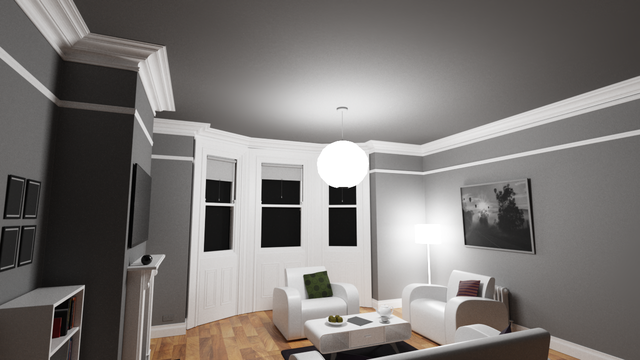
The paper isolates lighting error in synthetic scenes rendered with Mitsuba.
Geometry and materials stay fixed at ground truth. Only the estimated lighting changes.
The comparisons use IRGS and the authors’ reproduction of GS-ID’s illumination formulation and deshadowing model.
- Indoor lighting PSNR (dB): AEGIR 31.42; GS-ID 28.35; IRGS 11.26.
- Environment lighting PSNR (dB): AEGIR 30.22; GS-ID 26.35; IRGS 28.98.
Relighting and Scene Editing
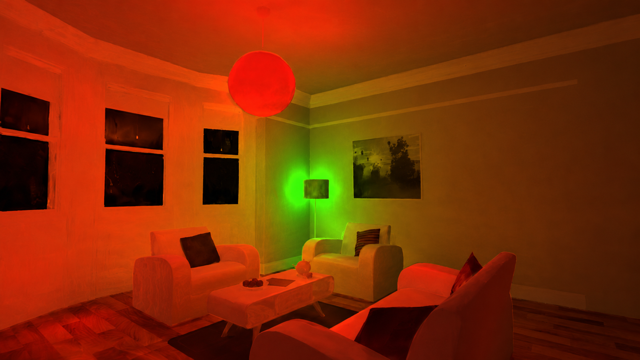
Editing individual emitters enables controlled relighting.
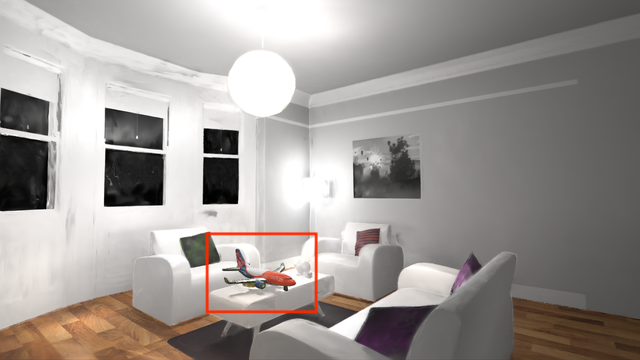
The recovered scene also supports virtual object insertion.
Limitations
- Noisy normals in textureless or occluded regions can cause shading artifacts.
- Ray tracing and sampling costs rise with emitter count, limiting larger scenes.
- The opaque microfacet material model cannot accurately handle mirrors or transparent glass.
More Information
Open Positions
JoinInterested in pursuing a PhD in computer graphics?
Never miss an update
FollowJoin us on Twitter / X for the latest updates of our research group and more.